Introduction
Most people build a portfolio by feel. I wanted the layer under that. Treat the personal site as a genre with rules, the way you'd read a corpus before writing in it, and ask a narrower question than "what's good": what have fourteen people who already cleared the bar independently decided is correct? Opinions about portfolios are cheap. A dataset is checkable.
Comparison
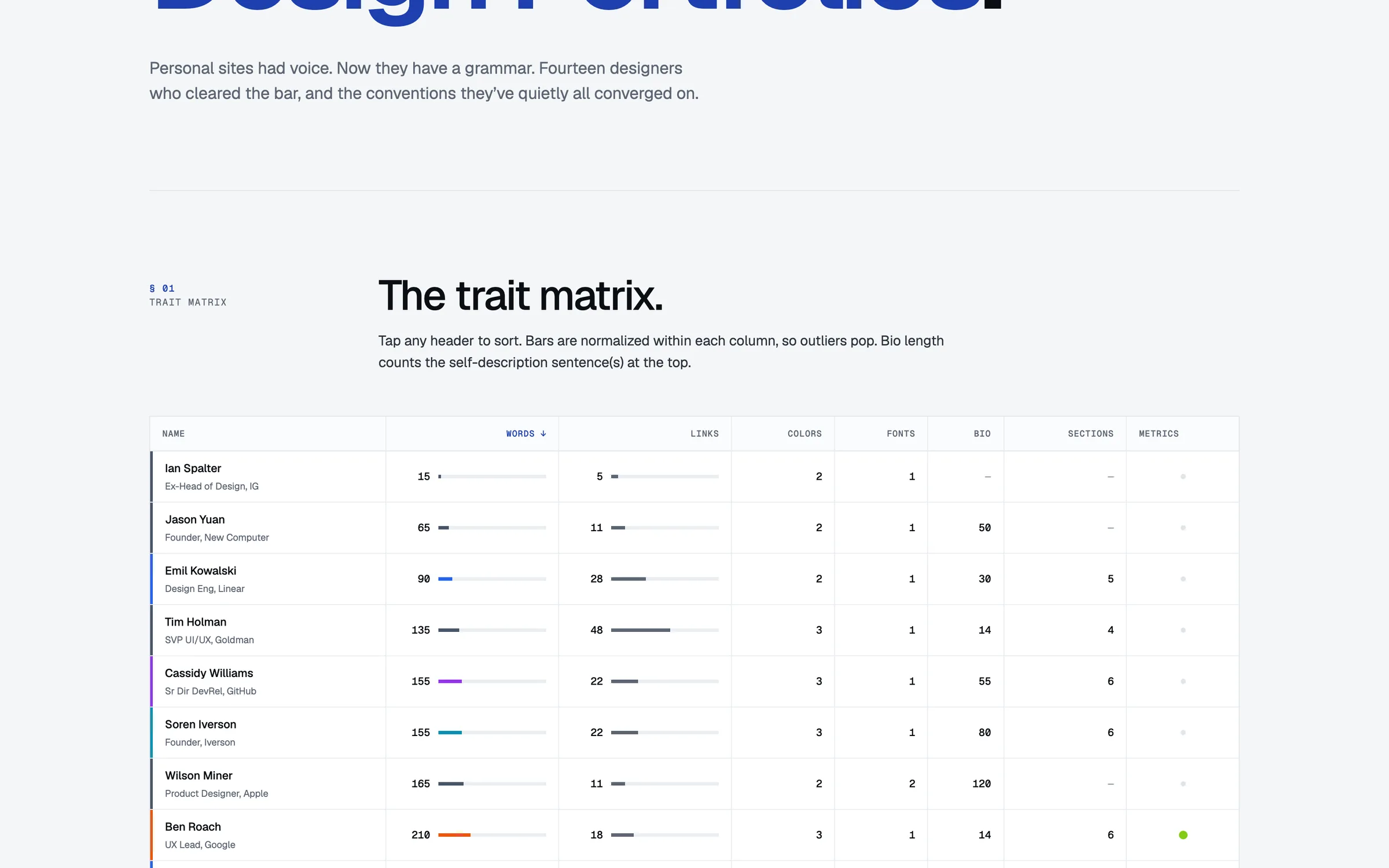
Normalizing the corpus. Fourteen sites, eight measurable columns: words, links, colors, fonts, bio length, sections, metrics. Every value normalized into a data bar so outliers stick out of the row, and the whole matrix is sortable. Tap Words and Ian Spalter's fifteen rise above Brittany Chiang's seven hundred. The reader re-ranks the evidence themselves instead of trusting my ordering. A few sites render in JS, so those counts are estimates; the table says which.
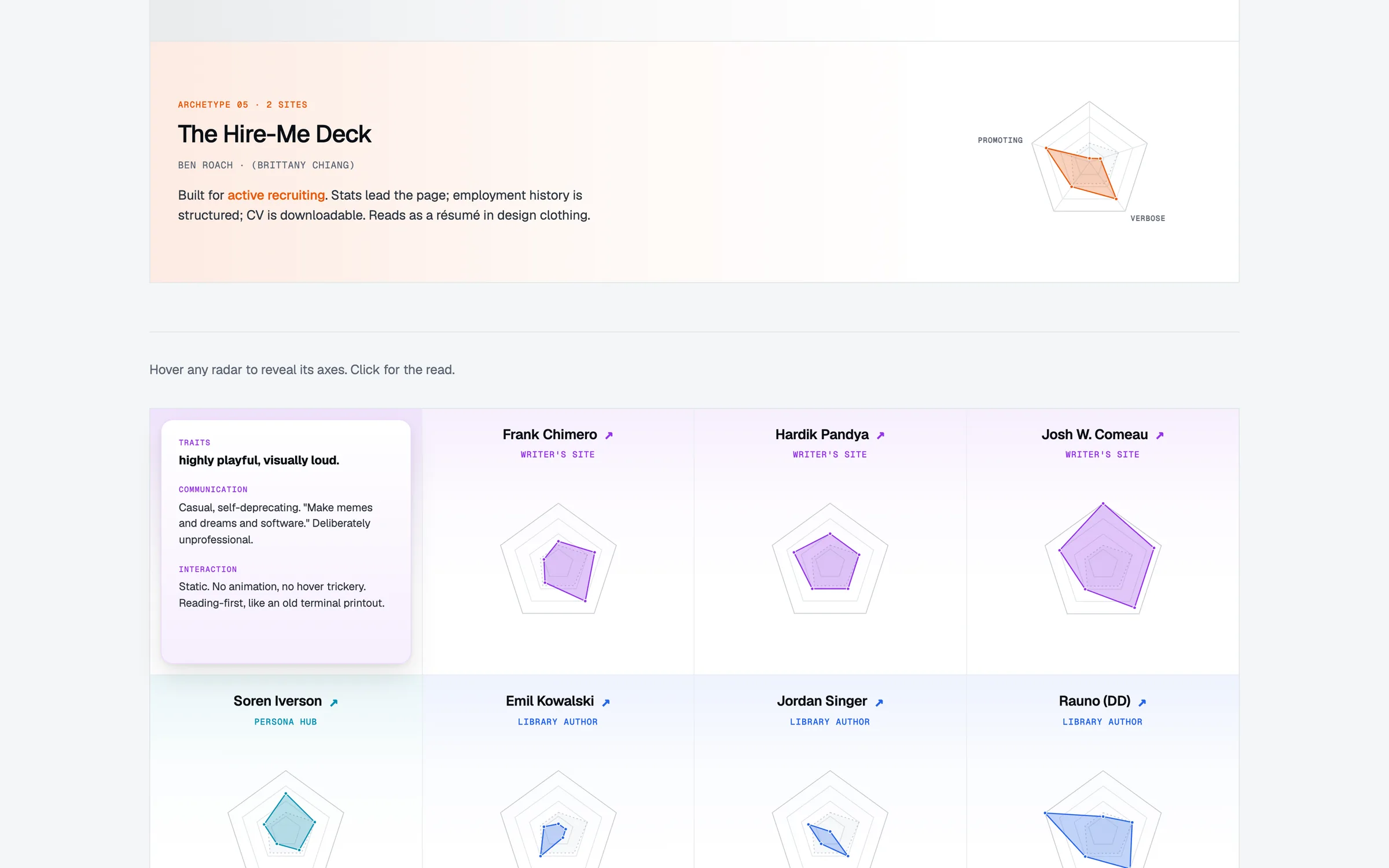
Reading against the median. A raw score tells you little on its own. So every site renders as a radar over the dashed pentagon of the corpus median, and you read the distance from it: Comeau bulges toward whimsy and word count, Spalter collapses to almost nothing, the library authors barely leave the middle. The deviation is the identity.
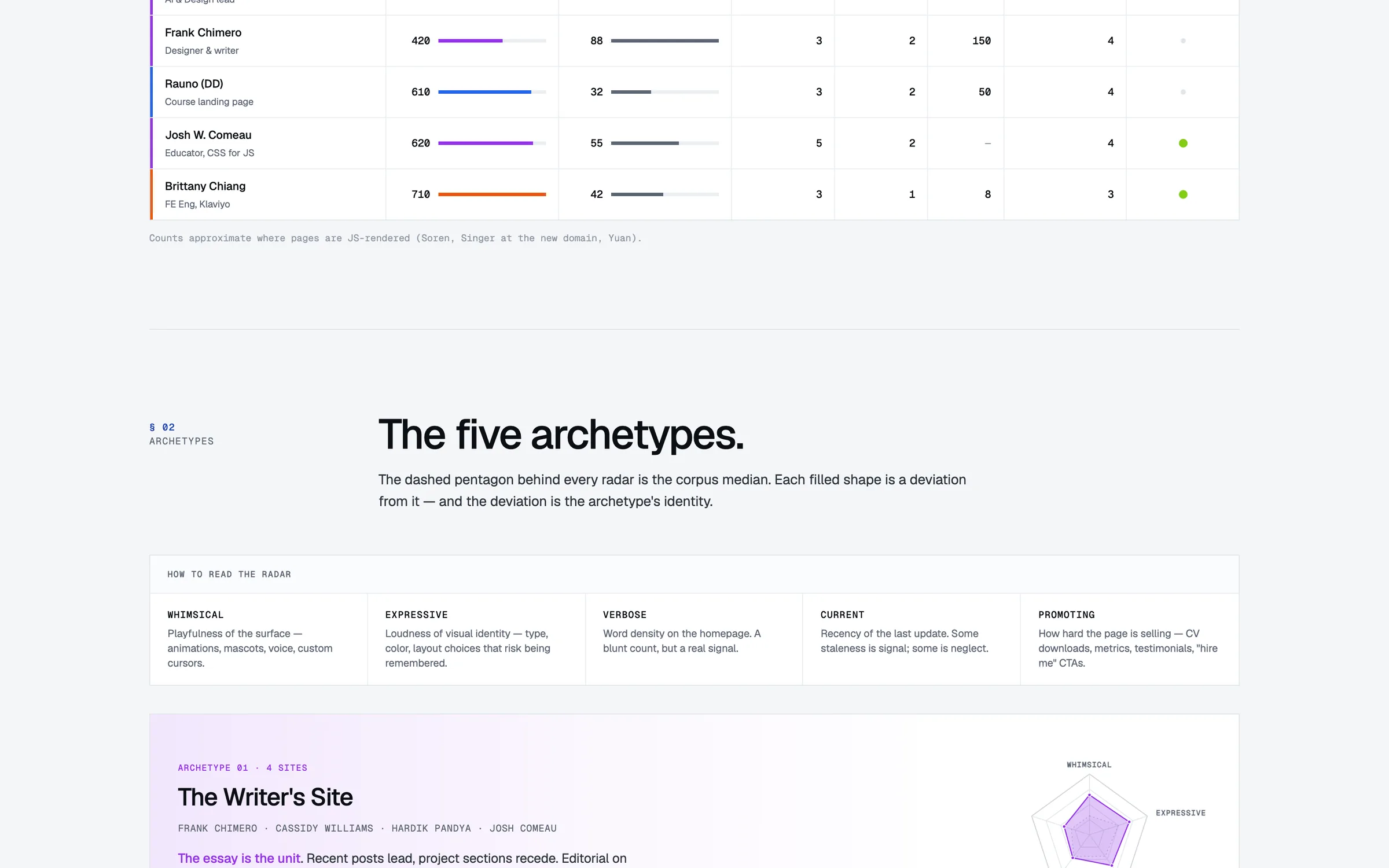
Clustering into archetypes. The deviations fall into five shapes: the Writer's Site, the Library Author, the Inside Joke, the Hire-Me Deck, the Persona Hub. Each archetype is a cluster that falls out of the columns rather than an impression. The matrix rows carry their archetype's color so the classification stays traceable back to the numbers that produced it.
The registers a number can't hold. A radar can't hear a bio or watch a page move. Past the charts sits a plain table for exactly those two things: how each site sounds, how it behaves. Chimero writes in paragraphs and lets one video loop carry the motion. Comeau drops confetti on a milestone. Spalter says nothing, and strikes through the little he does. Hover a card for its axes; click it for the written read.
Six standing patterns
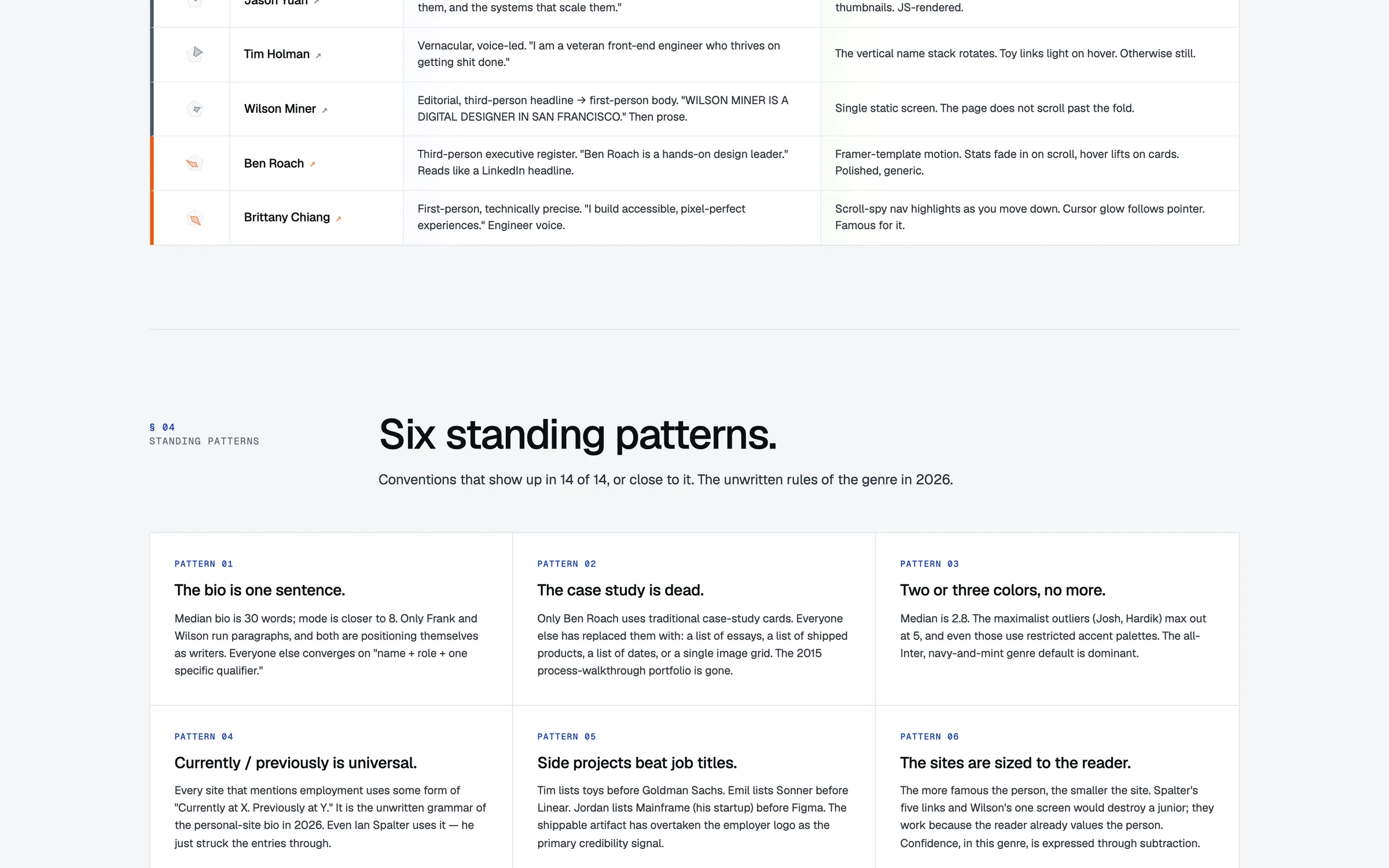
What turns up in almost all fourteen:
- The bio is one sentence.
- The case study is dead. One site of the fourteen still runs a traditional case-study grid.
- Two or three colors, no more.
- "Currently at X, previously at Y" is on every site that mentions a job.
- Side projects are listed before job titles.
- The more famous the person, the smaller the site.
Where this can be used
- Before building your own site: read the genre first, then decide where to conform and where to deviate on purpose.
- Portfolio reviews and teardowns: a shared baseline turns "I'd make the bio shorter" into "the corpus median is thirty words."
- Any small corpus you need to argue about: normalize, chart against the median, then write about what the numbers can't hold. The method transfers.
The tension I kept
One finding is in open conflict with my own situation, and I left the conflict in rather than papering over it. "The case study is dead" is what the corpus says, and it collides with the recruiter pipeline and the ATS behind it, which still want the structured, legible, full case study. That's a real fork, and there's no resolving it away: peer-legible, small-surfaced work on one side; recruiter-legible full case studies on the other. The study's practical output was knowing I'd have to pick deliberately, and probably build two surfaces, each sized to its reader. The site this study lives on is that decision executed.
The builder's takeaway
Under all six patterns is the same move: the people at the top of this field have stopped trying to convince you. They assume you arrived already believing, and spend the space on voice, or on almost nothing. Confidence, in this genre, is expressed through subtraction.
The method note under it: the finding only became arguable because the corpus was normalized first. "Portfolios should be shorter" is an opinion; "the median bio is one sentence and the most famous site in the set says fifteen words" is a measurement someone can check and contest. The charts aren't decoration; they're what lets the essay make claims a reader can verify.