I picked the mess on purpose
The title is a tell (Pattern Recognition; Some Oversimplified Stuff), and the ;SOS reads as a distress signal, because that's the register the audience actually lives in. This is the opposite of a thought-leader move. I label the simplification before anyone can call me on it, then open my hand: can we just look at a 2×2? Meet people where they are, strip the second and third layers of nuance deliberately, and hand them something small enough to hold.
Who it's for
People under about twenty-six. Paying taxes for the first few years, in their first jobs, sometimes already tired two years in. They don't need another framework with eleven boxes; they need language for validation, for their own psyche, for what actually gives them energy and what quietly drains it. Everything in the session is sized to that: if it doesn't fit in a 2×2, it doesn't go in.
Four layers, read down
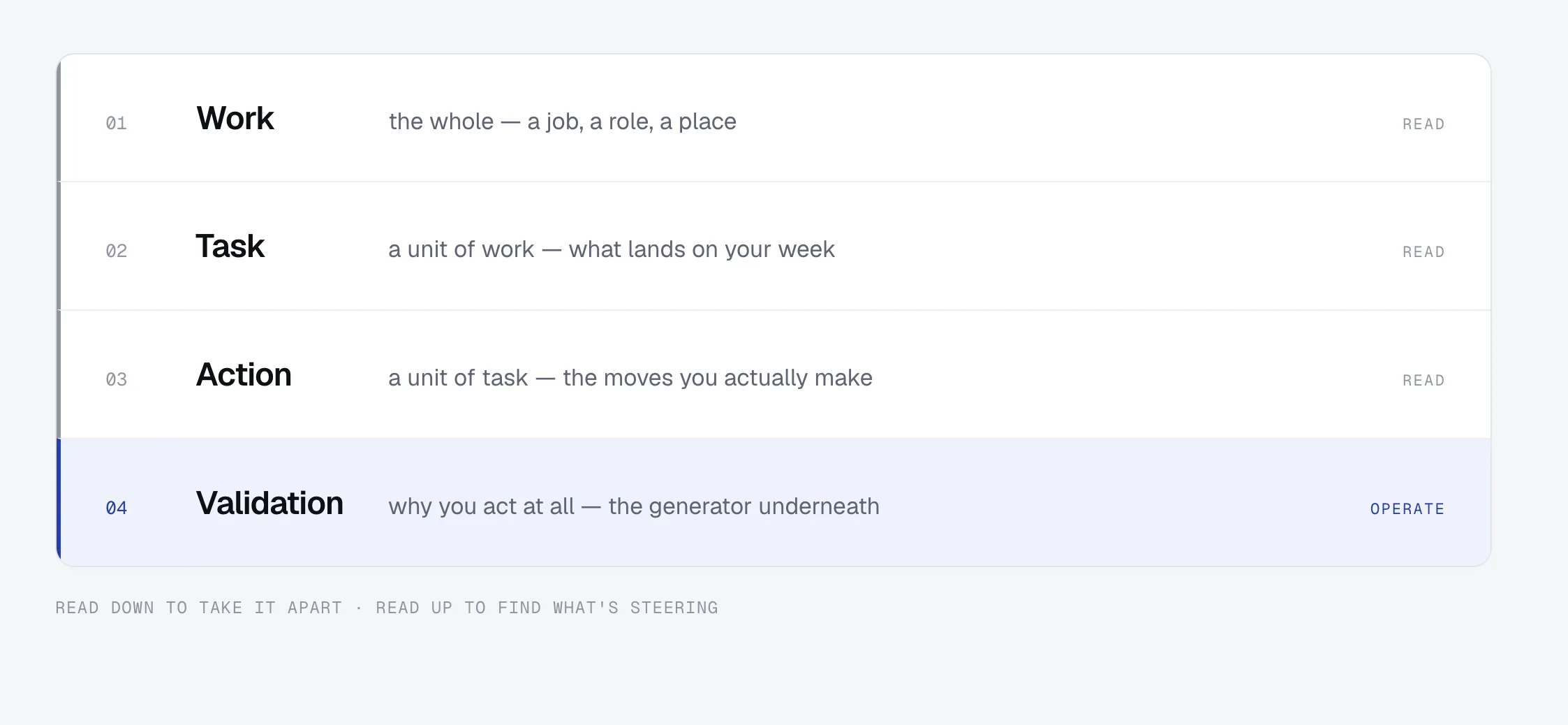
Work stacks vertically. Work: the whole role, split into what you know and what you don't. Task: the units you're assigned, urgent against important. Action: the specific moves you execute, impact against effort. And underneath, Validation: the why that's driving every choice above it. The rule of the stack: read down to take it apart, read up to find what's steering.
The first three layers each get a 2×2 you can read. The Work grid puts salary and location in the stable corner and the real unknowns (culture, power distance) in the quadrant that actually shapes your day. The Task grid is the classic urgent/important, with one square explicitly marked for deletion. The Action grid ranks moves by impact and effort, and names the killer: the low-impact, high-effort square, the drain, that quietly eats your week.
The grid you operate
The fourth grid works differently: you don't read it, you run on it. Validation swings between two poles, initiate and react, and it has a tempo it needs to keep. That's the metronome: some patterns need slow feedback loops, others need fast beats to stay stable. Its quadrants are diagnoses rather than advice: initiates-but-ignores-feedback is the self-wound; initiates-and-engages is high output, volatile; low on both is disengaged; and signal-dependent is moves when moved. The pattern doesn't sit still; it winds and stalls everything above it. "Moves when moved" at the bottom becomes "schedule keeps sliding" up in the task grid.
Same pattern, three rooms
The line that lands the room: leave the validation layer untouched and one failure wears three faces. The enthusiasm fizzles: the job was chosen on the visible factors, and the unstated culture ground it down. The review misses: feedback lands on the outputs while the pattern that produced them stays unnamed. The next job disappoints too: you changed the external conditions and the same metronome came along untouched. A new room fixes none of it. You keep fixing the layer you can see. The one you can't is steering.
The session is built live, through short discovery with a named room of people; a lecture wouldn't do it. That's the practice: watching someone find their own pattern inside the grids.